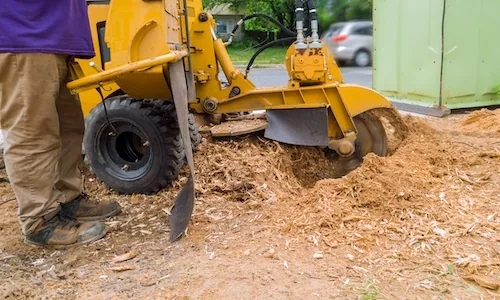
What stump grinding does
A stump grinder is a heavy cutting wheel fitted with hardened teeth. The operator swings it across the top of the stump in passes, lowering it a little each time, until the stump has been chewed down below the surface. The surface roots running out from the stump are followed and ground out as far as the quote says.
What grinding does not do is pull the stump and its roots out of the ground. The deeper roots stay where they are and break down over the following years. For a lawn, a garden bed or a patch of mulch that is fine. For a slab, a pool, paving or a retaining wall footing it is not enough, and you want full stump and root removal instead.
Most stump grinding in Perth falls into one of three jobs:
- Stumps left by a removal you are booking now. The easiest time to deal with it, because the grinder can come on the same visit or straight after.
- Old stumps left by a previous owner. Often softened by rot or termite activity, sometimes hidden under a garden bed or a pile of mulch.
- Verge stumps and strip-planting stumps. Rows of old conifers, hedges or screening plants along a fence line, which add up quickly.
Getting the grinder to the stump
Access decides which machine turns up, and it is the thing most people forget to mention.
Small walk-behind grinders are made for suburban backyards. They are narrow enough for most side gates and light enough to push along a path. The trade-off is that they grind more slowly, so a big stump takes longer.
Larger self-propelled and tracked grinders do the same job much faster and handle large hardwood stumps, but they need wider access, and some cannot go over steps or soft lawn without boards laid down.
Truck- or trailer-mounted machines are used on verges, open blocks and land clearing, where the grinder can drive straight up to the stump.
Before you ask for a price, walk the path the grinder will take from the street and note:
- the narrowest point, including gate posts, the meter box, hose reels and bins
- any steps, retaining walls or steep slopes between the street and the stump
- soft lawn, reticulation heads or fresh paving the machine will cross
- whether the stump is hard against a fence, wall, shed or pool fence
If a stump sits tight against a brick wall or a pool fence, the grinder may not be able to reach all of it. The arborist will usually cut back what can be reached and tell you on the quote what will be left.
How deep the stump is ground
For most jobs the stump is ground to somewhere around 200 to 300 mm below the surface. That is deep enough to lay turf, spread mulch or plant a garden bed over the top. If you want to plant another tree in the same spot, ask for a deeper grind and a wider area cleared of chip, because a new tree struggles in a hole full of fresh wood chip.
The depth goes on the quote. "Ground below ground level" can mean a lot of things, so a number is better.
What happens to the grindings
Grinding turns the stump into a pile of wood chip and soil, and the pile usually looks bigger than the stump did because the chip fluffs up. You have three options:
- Rake it back into the hole. Cheapest and quickest. The chip breaks down and settles over the next year or so, which leaves a shallow dip. Top it up with soil when it sinks.
- Use it on the garden. The chip makes a rough mulch for beds and around shrubs.
- Have it taken away. Best if you are turfing or paving straight over the spot. Replace the chip with clean soil or sand and firm it down.
Fresh wood chip mixed through soil can take up nitrogen as it breaks down, which is why turf laid straight over a backfilled stump hole sometimes goes pale. Removing most of the chip and using proper turf underlay avoids that.
Sandy ground, limestone and hills gravel
Perth soils change what a stump grinding job is like.
Sand on the coastal plain. Most of the metro, from Wanneroo and Joondalup down to Rockingham, is deep sand. Stumps in sand are usually straightforward to grind, but the roots run long and shallow, so there are often surface roots metres out across the lawn. Decide before the job how far those should be chased. Sand also throws further than soil, so expect a clean-up of paths and windows close to the stump.
Limestone near the coast. In suburbs like Spearwood, Cottesloe and along the coastal ridge, sand often sits over limestone, and roots grow into cracks in the rock. Grinder teeth do not like rock, so a stump growing on or into limestone may not be ground as deep as one in open sand. The quote should say if rock is likely to limit the depth.
Laterite and clay in the hills. Around Kalamunda and the scarp, stumps sit in gravelly laterite and clay, often on a slope. Grinding is slower, and getting the machine to the stump can be the main job.
Hardwood stumps. Jarrah, marri and many eucalypts are dense and slow to grind. A jarrah stump takes noticeably longer than a pine or a palm of the same diameter.
Stumps that grow back
Most trees die once the trunk is cut and the stump ground out. A few do not. Species that sucker or reshoot from the roots or the base can send up new shoots around the old stump for months after grinding. In Perth gardens the usual suspects are:
- white poplar and other poplars
- robinia and other locust trees
- olives
- coral trees
- tree of heaven
- WA peppermint, which suckers from the base
- many eucalypts, which reshoot from the base or a lignotuber
If you are dealing with one of these, grinding alone may not be the end of it. Ask the arborist whether the stump should be treated when it is cut, whether a wider area of root should be ground, or whether full stump and root removal makes more sense. Pull or cut any regrowth while it is small rather than letting it establish.
What is under the stump
A stump grinder cuts below ground, so anything buried near the stump is at risk: water pipes, reticulation lines, sewer and stormwater, gas lines, electrical cables to a shed or garden lights, and the telecommunications line to the house.
Before the grinder arrives:
- Lodge a free underground services enquiry through Before You Dig Australia for anything the network owners have in the street or the property.
- Mark anything private you know about, such as reticulation, garden lighting, a shed power cable or a septic line.
- Tell the arborist about any old plumbing that ran near the tree, especially where roots have been in pipes before.
Grinding near a known service is done carefully and sometimes stopped short. The quote should note if a stump is too close to a line to grind fully.
2026 stump grinding price guide
These are planning bands for 2026, in AUD. They are a guide only, and the final price comes from an on-site quote.
| Job | 2026 guide |
|---|---|
| Small stump, easy access | Under $100 |
| Single average stump | $100 to $400 |
| Large, hardwood or multi-stem stump | $400 and up |
| Several stumps on one block | Often priced by the hour |
Diameter matters most, followed by the timber (jarrah and marri are slow), how far the roots are chased, whether rock or services limit the grind, access for the machine, and whether the grindings are taken away. Grinding is usually cheaper per stump when it is done on the same visit as the tree removal. The tree removal cost guide puts these bands next to removal, pruning and palm prices.
Moving tree material
The whole Perth metro is a quarantine area for the polyphagous shot-hole borer, and there are restrictions on moving wood and plant material. If grindings or wood are leaving the block, the contractor needs to handle them properly. Our shot-hole borer guide explains what to look out for.
Getting a stump grinding quote
Send a photo of the stump with something for scale, such as a shoe or a bin, plus a photo of the side gate or path. Mention how many stumps there are, roughly how big they are, and what you want to do with the spot afterwards. The arborist will look at it on site and put the depth, the root work and the grindings on the written quote.