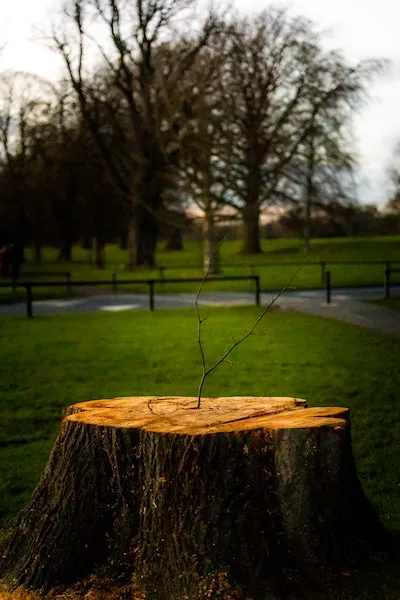
When a stump needs to come out completely
Most stumps in Perth backyards only need grinding. If the spot is going to be lawn, a garden bed or mulch, a grinder takes the stump below the surface and the roots rot away quietly underground. See stump grinding for that job.
Full stump and root removal is for the cases where something is being built or laid over the spot, and the ground has to be sound:
- Slabs. A new garage, granny flat, patio or extension, where a stump and its roots sit inside or near the footprint.
- Pools. The excavation for a pool goes deep, and pool builders want the stump and major roots out before they start.
- Paving and driveways. Roots left under pavers rot, the sand above them sinks, and the pavers dip and rock.
- Retaining walls and fences. Footings need firm ground, and a stump in the line of a wall is in the way.
- Replanting in the same spot. A new tree does better in clean soil than in a hole full of old roots and wood chip.
If you are not sure whether your project needs full removal, ask the builder, landscaper or pool company doing the next stage. They are the ones who have to build on the ground, and they will usually tell you exactly what they want cleared.
How a stump is removed
The method depends on the size of the stump, the soil and the access.
Small stumps and shrubs can often be dug out by hand. The roots are exposed with a shovel, cut with an axe or saw, and the stump is levered out.
Medium and large stumps usually need a machine. A mini excavator or a skid-steer with the right attachment digs around the stump, cuts or pulls the main roots, and lifts the stump out. On tight blocks a small excavator that fits through a side gate is used; on open blocks and building sites a larger machine is quicker.
Stumps against walls or fences may be ground back first so the machine can get at the root plate without pulling on the structure beside it. The quote should say how a stump hard against a wall or fence will be handled.
Once the stump is out, the arborist or contractor chases the major roots as far as the quote says, fills the hole, and compacts it.
Roots in Perth sand
Perth's coastal plain is mostly deep sand, and it shapes what comes out of the ground.
Trees growing in sand tend to put roots out wide and shallow, looking for water and nutrients. That means a stump in sandy ground often comes out with long lateral roots attached, running well past where the canopy was. A big eucalypt, pine or fig can have roots under a lawn, a path and a neighbour's fence line all at once.
The upside of sand is that it is easy to dig. Stumps in sand usually lift out more cleanly than stumps in clay, and the hole is simple to reshape. The downside is that sand collapses into the hole as you dig, so the hole is often wider than expected, and there is more fill to put back.
Near the coast, in suburbs like Cottesloe and Spearwood, sand often sits over limestone. Roots find their way into cracks in the rock, and a stump growing on limestone can be anchored in a way that makes it slow to lift. In the hills, around Kalamunda and the scarp, the ground is gravelly laterite and clay over granite, and extraction is slower again.
How far the roots are chased
This is the question to settle before the job starts, because it drives the price.
For a slab or pool, the builder usually wants the stump and all major roots out of the footprint, plus some distance around it. For paving, the roots under the paved area matter most. For a garden bed, taking out the stump and the biggest roots near it may be enough.
Fine roots are left behind on every job. It is not practical to remove every root from sandy ground, and the small ones break down without causing settlement. The written quote should say which roots are coming out, for example "stump and roots over 50 mm diameter within the pool footprint".
Filling and compacting the hole
A stump hole that is simply shovelled back in will settle. That is fine under lawn, where a top-up of soil fixes it, but not under a slab or paving.
For structural work, the hole is usually:
- Cleaned of loose roots, chip and organic material.
- Filled in layers with clean sand or the fill material your builder specifies.
- Compacted layer by layer with a plate compactor or the machine, and watered where that helps the sand settle.
- Left level, or at the height the next trade has asked for.
If your builder or engineer needs the fill tested or compacted to a particular standard, tell the arborist before the quote. That may mean coordinating with the builder's own earthworks rather than finishing it in one visit.
Bamboo and suckering plants
Some plants are harder to get rid of than a single tree stump, because what keeps them alive is spread through the ground.
Clumping bamboo grows in a tight, slowly spreading clump. Removal means cutting the canes, then digging out the whole root mass. It is heavy work, but it is contained.
Running bamboo spreads by underground rhizomes that can travel a long way from the original plant, often under fences and paving and into next door. Cutting the canes only buys time. The rhizomes have to be excavated, and any piece left behind can restart the whole stand. After removal, new shoots should be dealt with the moment they appear. Where a neighbour's bamboo is growing back in, a root barrier along the boundary may be needed. Our guide to neighbour tree disputes in WA is worth reading before that conversation.
Suckering trees such as poplars, robinia, olives and tree of heaven can send up shoots from roots left in the ground. Full extraction removes most of the root system and much of the problem, but check the area for a season afterwards and pull any new shoots early.
What else is in the ground
Stump removal disturbs more ground than grinding, so buried services matter even more. Before the job:
- Lodge a free underground services enquiry through Before You Dig Australia.
- Mark any private lines: reticulation, garden lighting, power to a shed, septic or old stormwater pipes.
- Mention old footings, rubble or buried concrete you know about, especially on older blocks.
Roots often wrap around old pipes, and it is common to find a broken or root-filled line once the stump is out. If that happens, the contractor will stop and let you know. Plumbing repairs are for a plumber, not the tree crew.
What stump removal costs
Full removal is priced on site. It costs more than grinding because it takes more time, heavier machinery, fill material and more waste going off site. The main factors are:
- stump diameter and species (hardwoods like jarrah and marri are slow to cut)
- how far the roots are to be chased
- soil type, and any limestone or rock
- access for the machine
- fill, compaction and removal of the stump and spoil
For comparison, grinding a single average stump sits around $100 to $400 as a 2026 guide, and less where the stump is small and easy to reach. If grinding will do the job, it is the cheaper option, and a good quote will tell you so. The tree removal cost guide has the full 2026 bands for removals, stumps and palms.
Before you book
Tell us what is going on the spot afterwards, and if you can, send the builder's or pool company's requirements. Photos of the stump, the access from the street and any structures nearby help. If the tree is still standing, the removal and the stump work can be quoted together.
Also check whether the tree itself needs approval before it is cut down. Rules differ by council, and the City of Cockburn now requires approval for most mature trees over 8 metres. Our guide to cutting down a tree in Perth explains what to check with your council.