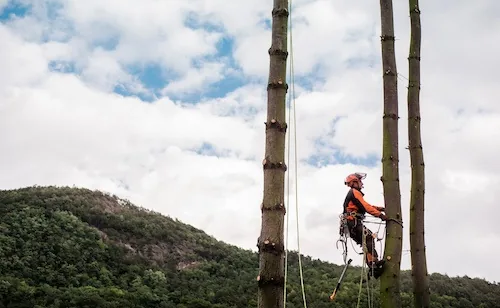
Hills blocks are a different kind of job
The City of Kalamunda runs from the flatter foothills suburbs of Forrestfield, High Wycombe and Wattle Grove, up the Darling Scarp through Lesmurdie, Gooseberry Hill, Maida Vale and Kalamunda itself, and out into the orchard and bush country around Bickley, Carmel, Walliston and Pickering Brook.
Tree removal in Kalamunda is shaped by three things the coastal plain does not have to deal with: slope, big native hardwoods, and bush right up to the back fence.
On the scarp and in the hills, many homes sit on larger blocks carved out of jarrah and marri forest, with native trees kept around the house when it was built. Some of these trees are very large, and a lot of them are on a slope above or below the house. Driveways can be steep and narrow, and a block may drop away sharply behind the house.
In the foothills suburbs, the ground is flatter and the blocks are more like the rest of suburban Perth, from established homes to newer estates. Access is usually easier, though big remnant trees can still end up close to houses.
Further out, orchards, hobby farms and bush lots bring larger-scale work: dead trees near sheds and tracks, trees over fences, and limbs down after a storm.
Laterite, clay and granite
Up on the scarp the ground changes completely from the sands of the coastal plain. It is gravelly laterite and clay over granite, often with rock close to the surface. Roots grow differently here: they find their way along cracks in the rock and through the gravel rather than spreading through deep sand.
What that means for the job:
- Stump grinding can hit rock. Granite or hard laterite not far below the surface limits how deep a grinder can go. Ask what depth is realistic before you plan to turf or build over the spot.
- Clay holds water in winter. Wet clay on a slope can be slippery and soft, which affects where a machine can safely go and sometimes when the job is booked.
- Trees on shallow ground can be less stable. A big tree rooted in a thin layer over rock, on a slope, deserves a proper look after heavy rain and strong wind.
Jarrah, marri and hills trees
Jarrah and marri are the trees most hills jobs involve. Both are dense, heavy hardwoods, and big ones produce a lot of timber to lower and remove. Other trees you will see around Kalamunda include sheoaks, banksias and grass-trees in the bush, pines and deciduous exotics in older gardens, and fruit trees in the orchard areas.
Two diseases are worth knowing about:
- Phytophthora dieback. Caused by Phytophthora species, it attacks a large share of the south-west's native plants, including eucalypts. DBCA describes jarrah as moderately susceptible, and affected trees may take years to die. People have spread it further and faster than any other means, through soil carried on vehicles, footwear and equipment. That is why good crews clean soil off their gear before and after working in the hills.
- Marri canker. Caused by a native fungus, it produces a target-like canker on the trunk or limbs that can ring-bark the tree. Marri shoot blight, caused by an introduced relative, affects the new growth of marri and red flowering gum.
If a tree is declining and you are not sure why, ask the arborist to look at it before deciding on removal. Sometimes removing a dead limb is enough; sometimes the tree is past saving.
Getting trees down on a slope
On a flat suburban block a tree can often be dropped in sections onto the lawn. On the scarp that rarely works. Wood cut on a slope tends to keep moving, and there may be a house, a retaining wall or a neighbour's shed below.
Most hills removals are done as a climb, with sections tied off and lowered on ropes to a safe landing spot. Logs may then need to be carried, winched or pulled up to the road, where the chipper and truck can reach. That handling is often a bigger part of the price than the cutting itself. Our tree removal page explains sectional removal in more detail.
After a winter front or summer storm, big limbs and whole trees can come down across driveways, roofs and fences. If that happens, see storm and emergency tree work for what to do first.
Bushfire season
Much of the hills is close to bushland, and tree work around the house is often about reducing fire risk: removing dead trees, clearing deadwood and bark build-up, and lifting or reducing limbs that hang over the roof and gutters. Try to have this done well before summer, when crews are busiest and conditions can restrict work. Check the City's current bushfire and firebreak requirements for your property, and tell the arborist what you need to meet them.
City of Kalamunda rules
Verge and council trees. The City says council-owned and verge trees are public property. Residents are only permitted to prune limbs that overhang their own property boundary. Anything more, including removing a verge tree, is for the City.
Trees on private land. The City's earlier tree retention policy has been revoked, and a replacement policy has been through public consultation. Check the City's current policy before removing a large tree, especially if you are building, subdividing or clearing part of the block.
Native vegetation. Clearing native trees can also need a permit under the state's native vegetation clearing laws unless an exemption applies, and some exemptions do not apply in environmentally sensitive areas. This is more likely to matter on bush blocks and larger lots.
Our guide on whether you can cut down a tree in Perth sets out the questions to ask before booking.
Shot-hole borer
The polyphagous shot-hole borer quarantine area covers the whole Perth metropolitan area, with rules on moving wood and plant material out of the Management Zone. Check your address on DPIRD's zone map before moving logs or firewood between properties, and see our shot-hole borer guide.
What tree removal costs in the hills
As a 2026 guide, a small tree in an open backyard often sits around $400 to $1,000, a medium tree $1,000 to $2,500, and a large jarrah or marri near the house $2,500 to $6,000 or more. Steep access, long carries and the weight of hills hardwood tend to push jobs towards the upper end of each band. These are planning figures only; the price is set on site. The tree removal cost guide has the full bands.
Getting a quote in Kalamunda
Call (08) 9560 6103, open 7 days from 8am to 5pm, or use the form. A photo taken from the road or driveway helps show the slope and access. We will arrange a local arborist to look at the tree and give you a written quote. We ask the arborists and contractors we work with to hold the public liability cover the job needs, so ask to see the certificate before work starts.
Straight answers
Do I need City of Kalamunda approval to remove a tree on my property?
The City's older tree retention policy has been revoked and a replacement policy has been through consultation, so check the City's current policy before removing a large tree, particularly if you are building or subdividing. Clearing native trees can also need a state permit under the native vegetation clearing laws unless an exemption applies.
Can I cut back the council tree on my verge in Kalamunda?
Only partly. The City says council-owned and verge trees are public property, and residents may only prune limbs that overhang their own property boundary. Anything more than that, including removing the tree, is a matter for the City.
Why does the arborist want to clean their gear before coming onto my block?
Phytophthora dieback is spread mainly by people moving infected soil on vehicles, boots and equipment, and jarrah is one of the susceptible species. Cleaning soil off gear before and after a job is the main way to avoid carrying it between properties. It is a good sign, not a delay.
Why do hills tree jobs often cost more than the same tree on the plain?
Slope and access. On a steep block the wood cannot simply be dropped and rolled away; it often has to be lowered on ropes and carried or winched up to the road, and there may be no room for a chipper or stump grinder near the tree. Jarrah and marri are also dense, heavy timber, which adds to the handling.
Free quote
Tell us about the tree
Send a few details and a photo if you have one, or call (08) 9560 6103. What happens next:
- A call back to talk through the tree and the access.
- A look on site, then a written price.
- A booked date, and a clean block when the crew leaves.